
いらっしゃいませ! Irasshaimasu!
Welcome and come in!
 |
| Okazaki Castle Park |
Joan from Foodalogue is taking us to Japan this week. I was very happy about this. Not only do I really really like Japanese cuisine, I am also very fond of Japanese culture and language.
So I would happily like to talk about everything Japanese, like for example the fascinating sumo tournaments:
 |
| Sumo tournament Nagoya 2010 |
and although sumo participents have a very special diet, it is not the purpose of this blog entry to explore their diet in depth; it would be be impossible anyway to share everything I have seen in Japan with you. So I will confine myself to Okazaki, for a special reason. First I had my language class there, so I spent several weeks in Okazaki. Second, although Okazaki is not the prettiest town in the country it has everything one expects from Japan. It has a castle:
 |
| Okazaki Castle |
it has temples

it even has some archaeology, like this long forgotten late Jomon settlement:

 |
| Okazaki, Hatcho (8th Street) |
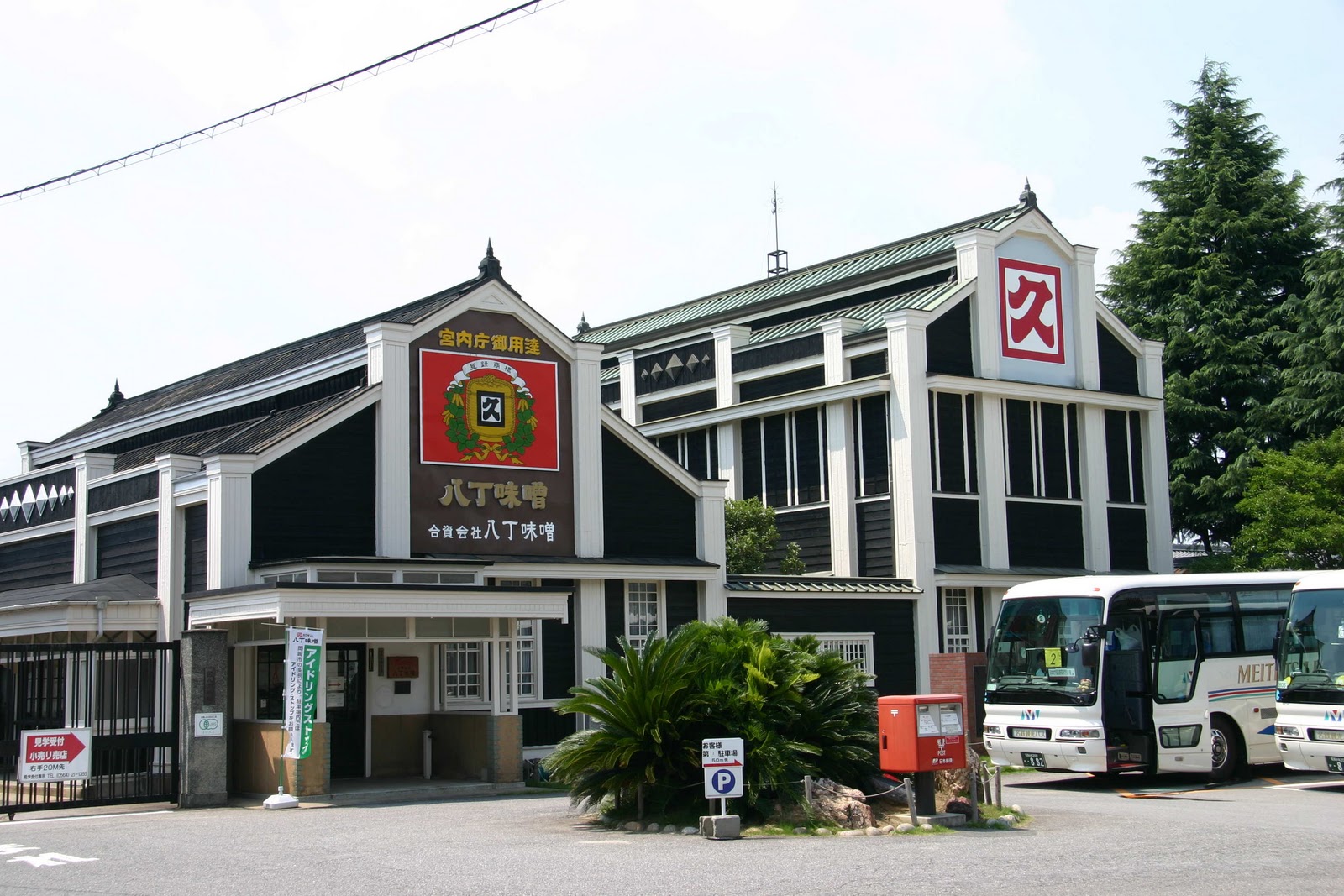
Hatcho miso show factory

Yes, I love my hatcho miso :)
Although I made other dishes (about which I will post next time and give you some super simple and delicious recipes) my entry will be about a very typical winter dish: nabe. Nabe simply means pot and it is indeed a kind of hotpot or stew.
Ideally it looks like this:
 |
| from the anime 'Yamato Nadeshiko Shichi Henge' |
 |
| from the anime 'Yamato Nadeshiko Shichi Henge' |
The most time consuming thing is cutting all the veggies:

You then put them into the broth (mine was a miso soymilk broth) and let it simmer:

Everybody then takes out what he wants to eat, puts it in his bowl and, with some condiments, starts eating:

Once all the vegetables are gone, you put pre-cooked udon noodles into the broth (I forgot to take a picture, we were too greedy again) and you can feast on the broth-soaked noodles. Yumyum!
For desert we had a matcha pudding (recipe from Wagashi Maniac).

C got creative:

And here is the promised recipe for the nabe. It's vaguely based on Zakuro's vague recipe (thank you Zakuro, it was delicious ^-^)
豆乳 nabe (soymilk nabe)
Ingredients:
for the broth:
4 cups of kombu stock
1 cup of soymilk
2 tablespoons of miso paste (I used red hatcho miso)
for the veggies:
whatever pleases you, I used bean sprouts, lotus root, leek, carrots, enoki mushrooms, daikon, green beans, and white cabbage
for the noodles:
same here, use your favourite ones, I used udon noodles
What to do:
combine stock, miso, and soymilk and bring to a simmer. Add the veggies in small arranged piles and let simmer till soft. Everybody is supposed to take out his portion and then put fresh veggies into the broth until everything is used up. While the noodles are soaking up the last broth, serve the veggies with ponzu, grated daikon and chili oil. Enjoy!
Amatou from Wagashi Maniac gave me permission to translate and post her yummie matcha pudding recipe (本当にありがとう!) :
Matcha Pudding
450 ml ( a bit under 2 US cups) unsweetened soymilk
10 g (3 teaspoons) kudzu (a starch made from the roots of Pueraria lobata, a kind of pea)
3 g (1 teaspoon) kanten (agar) flakes
50 g (1/4 cup) caster sugar
1-2 tablespoons matcha powder
1/2 vanilla pod
2 tablespoons matcha syrup
2 tablespoons macha licquer
berries (blueberries or other berries of your choice)
2 tablespoons Kuromame ama-ni (black sweetened soy beans)
Use 3 tablespoons of soymilk to dissolve the kudzu powder. Slowly heat the rest of the soymilk together with the cut up vanilla pod and the agar flakes for about 5 minutes.The agar should be completely dissolved. Bring to the boil and add the kudzu-milk mixture. Stir until it thickens, then reduce heat.
Mix the matcha powder and the sugar and add in two to three steps to the hot pudding. If desired add some licquer and syrup.
You can pour the pudding through a sieve to filter out vanilla grains and small lumps of kudzu or agar (I didn't, love all my vanilla grains in the pudding *hehe*)
Rinse 4 small ramekins with cold water and pour in the pudding. Let cool over night, or at least a couple of hours at a cool place.
Before serving mix the matcha syrup and licquer and drizzle over the pudding. Serve with berries and kuromame.
I didn't have matcha syrup and licquer (although you can quite easily make them yourself as Amatou demonstrates on her blog - I definitely have to try this). Instead I simmered blueberries with a lemon wedge and some brown sugar and used them instead of the licquer and the kuromame.


 The central point of the exhibition is a piece of a 'fossilzed' excavation trench:

