Showing posts with label wagashi. Show all posts

Monday, March 21, 2011

Kitchoan's Wagashi - Kurihoka (Bean Jelly) Review

In a recent post I told you about my shopping in London's Kitchoan, a Japanese shop specialising in wagashi, Japanese traditional sweets. Today I want to show you one more wagashi I bought at the shop. It is called Kurihoka:


Ingredients: Water, granulated sugar, sugared chestnut, red bean, trehalose, agar-agar, salt, colour (gardenia), sulfite

The taste was ... well, ok. I had eaten better chestnut and red bean based sweets in Japan. It was not really bad though, but not exciting either. The centre was a sugared chestnut with a sort of rough red bean mash engulfing the chestnut.

 But now to the 'natural ingredients'. I guess you could call sulphites 'natural', and it is most certainly used to keep the chestnut from discolouring. On the other hand sulphites do pose health risks. Sulphite sensitive people and people suffering from Asthma, are prone to reactions similar the one caused by food allergies. Is it really unavoidable? No, ascorbic acid would have done the trick and with no ill effects.

The second point is trehalose. Why on earth did they put this novelty sugar in it? This time we can't speak of a natural ingredient. Although some fungi, insects, and bacteria do possess natural trehalose, the one put in our food is not: "Hayashibara started manufacturing trehalose by activating two enzymes, the glucosyltrehalose-producing enzyme that changes the reducing terminal of starch into a trehalose structure, and the trehalose free enzyme that detaches this trehalose structure. As a result, a high-purity trehalose from starch can be mass produced for a very low price." (Wikipedia). The product trehalose seems to be safe from a health aspect, altough it is not even yet known how many people do indeed possess helase, the enzyme to split the double sugar and digest it - after all we are neither fungi nor insects. There may very well be the same risk of intolerance as when adding lactose to food products. Furthermore the two main enzymes "were not evaluated completely to JECFA standards for general food safety. The Committee VNV agrees with the first assessor that the applicant should be strongly encouraged to submit the enzyme preparations for formal evaluation." Meaning there is still enough uncertantity about this novel food.

Do we need it for a good (or in this case mediocre) wagashi? Definitely not!

If you want to go for your own version (and I cannot encourage you enough), there is a chocolaty version on E-recipe and a kind of 'deconstructed' version on cookpad.com.

Friday, March 11, 2011

Wagashi and a bit of history

Wagashi are Japanese traditional confectionaries. When, during the Meiji period, western style sweets (洋菓子, yougashi) were introduced into Japan, traditional sweets were re-named Wa-Kashi  (和菓子, wagashi) in order to distinguish them from the western ones. The Wa refers here to the oldest name for Japan, already mentioned in a 2300 year old text from China.

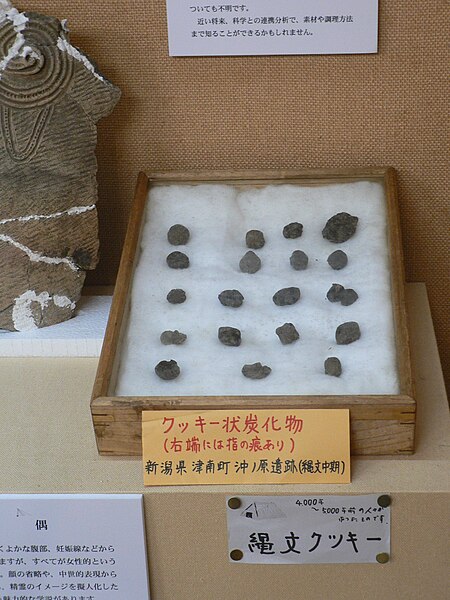
Although an often cited 'cookie' is known from the Jomon period, the Jomon cookie had nothing in common with today's wagashi sweets. It consisted of chestnut and walnut flour, meat and blood of wild boar and deer, and wild bird eggs (Imamura 1996, 99). You can rather look at it as a savoury patty. Carbonized 'cookie' remains have for example been found at the middle Jomon site of the Okinohara site 沖ノ原遺跡(Niigata pref.) about 4000 to 5000 BCE.


A roundhouse from the site of Okinohara 沖ノ原遺跡
http://www.niigata-kankou.or.jp/tunan/kyoukai/institution/4056.html

Jomon carbonised 'cookies'
http://upload.wikimedia.org/wikipedia/commons/thumb/3/34/Jomon-cookies_from_Okinohara.JPG/450px-Jomon-cookies_from_Okinohara.JPG

Thus during the Jomon to Nara period Okashi consisted probably of fruits which is also suggested by the Kanji 菓 in the name of wagashi,  which simply stands for fruit. Sugar was only introduced during the Tang dynasty, when a monk imported it from India via silk route to China and from there to Japan (Nara period). During the Qin Dynasty sugar cane rock (crystallised cane sugar sap) was traded extensively along the silk route, but still used as a precious luxury good. Only during the Edo period sugar became more available and the production of wagashi began to flourish. Although many recipes originated from Chinese sweets, together with the art of tea ceremony, wagashi became much more refined and new varieties were invented for this purpose.

But enough of history lessons :) let's have a look at a contemporary wagashi, bought at Minamoto Kitchoan in London:


This wagashi is called Yuka and is basically a citron jelly. Sounds simple but is a perfect balance of ingredients and tasted lovely in combination with our flowering tea. Main ingredients: Sugar, water, kidney bean, citrus fruit and agar. If you want to try your hand on it ... a similar lemon sweet can be found at Wagashimaniac's blog (Remon-kan).