Wednesday, October 03, 2007

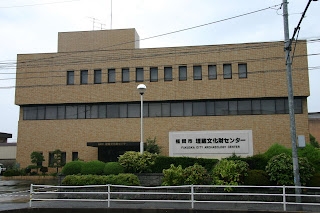
Fukuoka City Archaeological Centre

At my last weekend in Fukuoka I went to the Fukuoka City Archaeological Centre. Part of the Universtity, it offers a small but very interesting exhibition with lots of information about excavations in the Fukuoka area and the restauration of the finds thereof.

Just to show you some nice pottery (I know you are desparate to see all the Jomon and Yayoi pottery pics, but M. fell asleep when I showed him my pictures, therefore I will spare you the whole bunch of them). But have a look at the little bird, engraved in the neck of a vessel:


Pretty, huh? And these cylindrical haniwa from the Kofun period are a must-see, too:


At the hands-on corner, you could experience how Jomon people made different impressions into the still soft clay of the pottery. Fun for kids, who can use different shells, bamboo stamps, etc. for their artistic expression.


On my way home I stumbled over this old wooden house with a vending machine at the front. Vending machines for drinks are everywhere in Japan and I don't know what I would have done without them. There is nothing more wonderful than a cold green tea when it's really hot.

Tuesday, October 02, 2007

How tu use a Japanese Toilet

Don't ask me ;) I haven't tried all features so far. This is one of the more simple toilets (nothing is easy in Japan *sigh*):


Monday, October 01, 2007

Dazaifu - again

Jeeeeez. It's been too long. But since I left Fukuoka I had no free internet anymore and internet cafés are rare and expensive. But do not fear I will keep you informed about what happened during the last couple of weeks in Japan.
I went to Daizaifu - again. And I couldn't resist the mochi - again. Although I'm not very fond of sweets, you just have to eat at least one mochi rice cake, filled with adzuki bean paste. Yes, it's awfully sweet, but then, hey, that nun baked them all the time for that scholar I told you last time, Michizane. Mochi bakeries and souvenir shops line both sides of the boulevard leading to the shrine:


And here you can admire the omnipresent Koi in Japan's ponds:


Saturday, September 01, 2007

Noh play

At the Kyushu National Museum there was a demonstration of Noh today. Noh is a play with masks and strange music with drums and monotonous singing. The example we saw was about a demon that fought against some priests and was finally destroyed by them.
This is a mask similar to the one the demon was wearing:

And this is the expert who explained everything to us. In the background the different Kimonos used for the play and in front of him different masks that are utilized during the show:

Hanabi in Ohori Park, Fukuoka


Today are the last hanabi (fireworks), which means the official end of the summer. since I don't have a video camera, have a look at last year's hanabi from Ohori Park in Fukuoka.
It marks also my last day at school. I finished my language course yesterday und we had a farewell party in the evening, whitch ended at a karaoke bar. With enough o-sake it is really fun. But don't try it sober :)

Fukuoka

I love these tiny shrines in the midst of busy streets:


A shopping arcade in Hakata-shi:

And a 'Wohnung' (sorry only funny for German speakers):

Friday, August 31, 2007

Canal City at Night

The dancing fountain in blue:

Nightly artist at the Canal City Stage:


Wednesday, August 29, 2007

Itazuke

From Kanenokuma I took a taxi to the Itazuke Ruins. Itazuke is the oldest known Yayoi settlement. As you can see this outsiders (coming from China and Korea) were not very welcome on the Japanese islands. All Yayoi settlements were fortified with banks and ditches/moats:


This is the reconstructed site which looks a little bit odd between the skyscrapers of Fukuoka:

Here you have closer look at one of their houses:

And here are the inhabitants of the village. Isn't that one happy Yayoi family? By the way, the woman in the back looks very suspiciously like one of my Japanese teachers here at Genki School:

And here is negativ of a footprint. Don't ask me whether Japanese people have this kind of feet, I haven't had the oppurtunity to check it.

And a little bit of archaeology; this is a reaping knife for rice used by the Yayoi culture:


Tuesday, August 28, 2007

Kanenokuma 'Ruins'

Sunday morning I spent more or less underground. I knew that there was a Nishitetsu Bus going to Kanenokuma, so I went to the Tenjjin main station and asked which bus I had to take in order to get to the site of Kanenokuma. After studying various maps the lady decided that the bus would leave from Hakata station, so I took the underground and went to Hakata station. At the informatin desk the same thing happened. Maps were drawn out from beneath and the equally friendly lady told me to go to Fukuoka airport station. That would be where the bus would leave. So again I vanished into the underground and took the metro to the airport. Meanwhile I was reallly hungry and took a break at one of the many coffee bars that exist beneath Fukuoka.

This time I was at the right place, so all I had to do was to ask someone which bus line I had to take, because -as usual- Kanji only! The bus driver put me off in the middle of an industrial park area and after asking the people at a petrol station I really mananged to find the sign (meanwhile I knew how Kanenokuma was written in Kanj) leading to the site.

And here it is. I am proudly presenting the middle to late Yayoi burial site of Kanenokuma:


The central point of the exhibition is a piece of a 'fossilzed' excavation trench:


In contrast to other periods a lot of child burials existed in the Yayoi time. At this huge burial ground more than 50 % of the burials are children's. Here an example of a jar burial tyical for the middle Yayoi period:

You may remember that last week I battled the dangerous water snakes. This week I had to cope with the even more dangerous water frogs:

But this might explain the high death toll among the Yayoi children :)

Monday, August 27, 2007

Depaato

I love crooked escalators :)
Buying cars in a department store is nothing unusual in Japan:

Koumyouzenji Temple


Still in the Daizaifu area, a small temple with a beautiful stone garden:


Sunday, August 26, 2007

Kyushu National Museum

The newly built Kyushu National Museum is situated in Daizaifu. The very modern museum


stresses the connection of Japan with the Asian continent but also with the Western world. No photography was allowed here but the 'devil tile' (oni-gawara) that once decorated the end of the roof ridge of the Dazaifu Government Headquarters (c. 8th century) was in the outer hall so I have got a photo of this one. The design of the tile shows the influence of Silla, the ancient kingdom of the Korean peninsula.


For comparison, the latter tile is from Korea (unified Silla Period, now BM).

It's a real pity I couldn't take photos because there were really beautiful artefacts here from the Palaeolithic up to modern times. But it seems to be a rule here that museums with expensiv entrance fees do not allow photo shooting whereas the smaller ones, which are free, are also very generous.

Saturday, August 25, 2007

Daizaifu

Weekend! Time for field trips. Today I went to Daizaifu. Today it's a small town outside of Fukuoka, but during the 8th to 12th century it was the most important administrative and military centre in all Kyushu. After the Mongolian invasian Hakata (=Fukuoka) became the most important town in Kyushu.

Today it's a huge park-like recreation area which also hosts a number of museums and temples.


This is one of the bridges leading to the Shinto shrineTenmango. This shrine worships Sugawara Michizane (a 9th century sholar) as "God of Scholarship" who was exciled and spent the last two years of his life in Daizaifu. After his death they built a temple to calm down the ghost of Sugawara Michizane who was obviously responsible for a series of catasthrophies.

Although in folclore the God bird "Kiuso" was worshipped (looks like an owl) there are definitly more turtles here than owls. They are everywhere in the ponds and lakes of this site, there are numerous statues and even the big water basin in front of the temple is featuring the 'kame-sama'.

You have to look closely at the bottom of the basin:


A little shrine in the Daizaifu park area:


A wealth of little shops is plastering the street from the station to Daizaifu proper and one thing you definitly have to try is a toasted mochi, a specialty of the area. It's a rice cake filled with sweet azuki bean paste. Try it hot! Oishii!!!


Friday, August 24, 2007

Famous Food in Fukuoka

Tonight I went to the cinemas. As everywhere American movies dominate the scene. Since I didn't want to watch an American movie in Japan (and apart from that I already watched all the blockbusters) I didn't have a big choice. So 'Naruto' it was. It's an anime and based on a very popular manga. Unfortunately there were no subtitles, but since it was the same old story about the good and the evil it was ok. I guess it was good for learning Japanese and it was actually nicely done.

http://umauma-y.com/eiga/Poster/no3151-001.jpg

On my way back I watched a film team at one of the side street restaurants 'Mutchan':


To be honest, I don't even know what kind of food they are offering, but it must be pretty famous, since a TV show camera team showed up. The only thing I know is that they cook something on a hot plate. Hm....maybe I will go there one day and have a closer look.


Tuesday, August 21, 2007

Canal City

Canal City is a huge shopping and entertainment complex situated along an artificial canal. The modern architecture alone is worth a trip to Canal City:


Kids have their fun here, too:


and there are regular performances on the Canal City Stage:

The best thing, however is the dancing fountain: